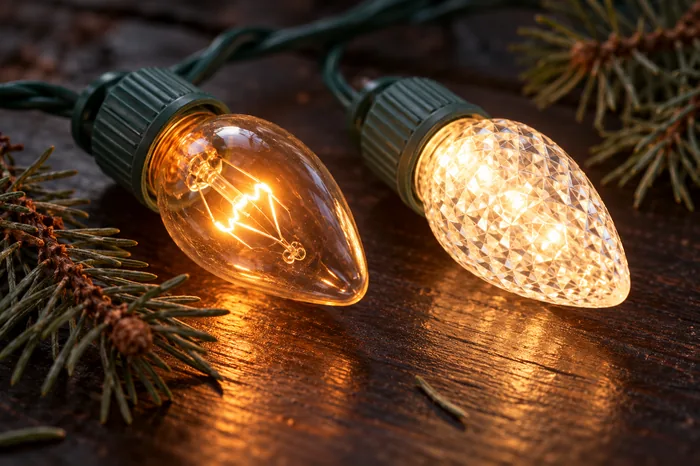
LED vs incandescent Christmas lights: what it really costs
The Department of Energy puts LED strands at 70 percent less electricity than incandescent ones, and for big C9 bulbs the gap is wider, about 96 percent in the example below. LED lights also run cool and last for many seasons. Incandescent lights cost less to buy, glow a warmer color, and use far more power. For anything outdoors, LED is cheaper over a few seasons and safer on the circuit.
Electricity: a worked example
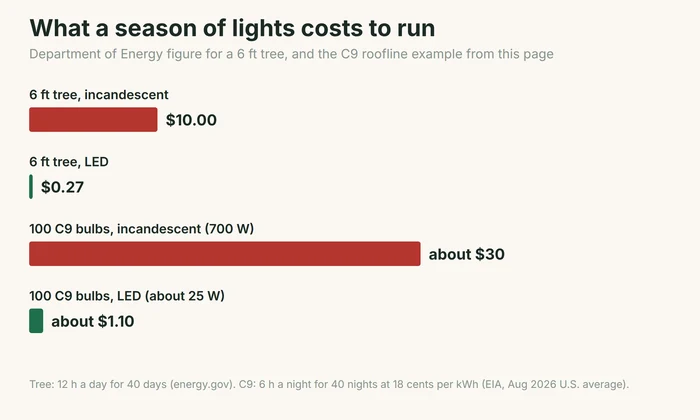
Energy.gov puts the season cost of lighting a 6 ft tree for 12 hours a day over 40 days at $0.27 with LEDs and $10 with incandescents (Energy.gov). For a roofline, take 100 C9 bulbs run 6 hours a night for 40 nights, which is 240 hours, at 18 cents per kilowatt-hour, close to the August 2026 U.S. average residential price of 18.16 cents (EIA):
| Incandescent C9 (7 W each) | LED C9 (about 25 W per 100 ft string) | |
|---|---|---|
| Total watts for 100 bulbs | 700 W | About 25 W |
| Energy for 240 hours | About 168 kWh | About 6 kWh |
| Cost at 18 cents per kWh | About $30 | About $1.08 |
Your local rate and hours will differ. Multiply watts by hours, divide by 1,000 for kWh, then multiply by your rate. The bulb wattage is on the package.
The same roofline at three electricity prices
Your state changes the incandescent bill a lot. The August 2026 EIA averages for residential power were 18.16 cents in the U.S., 30.48 cents in Massachusetts and 29.75 cents in California (EIA). The 7 W bulb figure is from Christmas Light Source; the LED figure is the calculator's typical 100 ft string, and the box shows yours.
| U.S. average | Massachusetts | California | |
|---|---|---|---|
| Incandescent | $31 | $51 | $50 |
| LED | $1.09 | $1.83 | $1.78 |
Other differences
| LED | Incandescent | |
|---|---|---|
| Purchase price | Higher, often 2 to 3 times | Lower |
| Lifespan | Many seasons, often 10 or more | A few seasons, bulbs burn out |
| Heat | Cool to the touch | Hot, a risk near dry greenery |
| Strings you can join | Often 20 to 40 sets | Usually 3 to 4 sets |
| Color | Crisp, a bit bluer even when warm | Soft, golden glow |
| If a bulb fails | Usually the rest stays lit | Often the whole section goes out |
| Fragility | Plastic bulbs, hard to break | Glass, breaks when dropped |
The look people miss about incandescent
Old incandescent bulbs have a soft golden glow. Modern warm white LEDs are close, but some look slightly harsh or blue at the edges. The fix is to buy a warm white or candlelight LED from a reputable brand and test one string at night before buying a lot. Look for a string that shows the color on the box, not just the word warm.
LED multicolor looks brighter and more saturated than incandescent multicolor, which some people like and some think is too bright.
Which to buy
- Outdoors, any size: LED, because of the power draw and the number of strings you can connect. See how many strings can you plug together.
- A tree you love the old look of: incandescent can be fine for a single small indoor tree, but the heat is a risk on a dry tree.
- Commercial-grade LED: worth the premium for a roofline you will reuse. It is brighter and has replaceable bulbs. Compare bulb sizes in C9 versus C7 versus mini.
- Not sure about the look? Warm white versus multicolor shows both on one house.
Whichever you pick, preview the look on your house first. Preview it on my house, free
Frequently asked questions
Are LED Christmas lights worth it?
For outdoor lights, almost always yes. They use a fraction of the electricity, you can connect many more sets, and they last many seasons.
How much cheaper are LED Christmas lights to run?
The Department of Energy says LED strands use 70 percent less energy, and for C9 bulbs the saving is larger. DOE's own example is a 6 ft tree: $0.27 with LEDs and $10 with incandescents for a season. A 100 ft run of C9 might cost about $30 with incandescent and about $1.10 with LED at 18 cents per kWh.
Do LED Christmas lights get hot?
No. They stay cool to the touch, unlike incandescent bulbs, which get hot enough to dry out greenery.
Why do LED Christmas lights flicker?
Mostly cheap sets that rectify the current to half-wave, so the LEDs pulse faster than you notice until you see them out of the corner of your eye or on camera. A dimmer or timer that is not rated for LED loads can also cause flicker. Try another brand of set, or a timer or smart plug rated for LED.
Can I mix LED and incandescent strings?
Do not connect them end to end unless the package says you can. Keep them on separate runs and watch the total load.
See it on your house
Upload one photo of your house and preview Christmas light styles on it. Free, no sign-up for your first three.
Preview it on my house, free- 24 styles to compare
- Parts list and DIY cost for each
- Photos deleted after 30 days
Ready when you are
Upload a photo and preview a look in about a minute. Free, no sign-up for your first three styles.